Product engineering
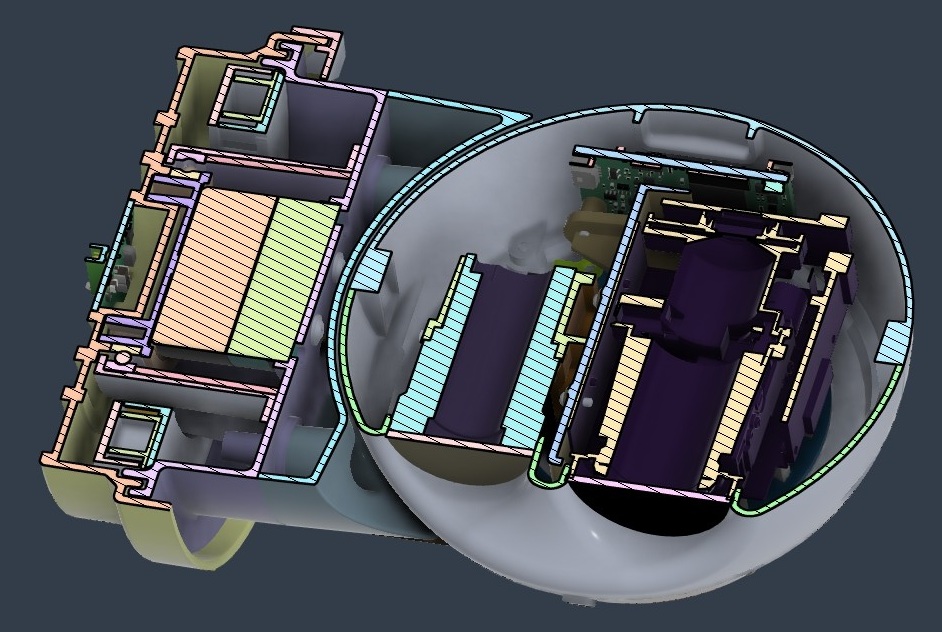
A 3-axis gimbal for serial production
Parts designed for injection moulding, checked with FEA before tooling is committed.
See the project

When loads change quickly, inertia matters. Dynamic analysis shows how a part or a machine vibrates, which frequencies to avoid, and what happens in an impact or a drop.
Dynamic results depend strongly on damping, mass distribution and how the part is held. We state these assumptions, and for impact we recommend confirming the result with a physical test.
Commercial FEA packages often cost thousands of euros a year per seat, and that cost ends up in the price of every study. We work with a mature open-source toolchain instead, so an SME pays for engineering time, not for software licences.
The solver, CalculiX, is a long-established finite element code that reads the widely used Abaqus-style input format.
Where a question genuinely needs a feature that only a commercial package offers, we say so before the work starts.
The CAD model is prepared for analysis and simplified where details don't affect the answer.
Materials, loads, supports and contacts are defined, each assumption is recorded, and the mesh is refined where stresses concentrate.
The model is solved and checked: convergence, mesh sensitivity and plausibility against hand calculations.
Stresses, displacements and reactions are extracted and presented as clear images and figures for the decision.
Product names are trademarks of their respective owners.
Tell us what you are developing, changing or trying to fix. We first look at the engineering question, then say plainly what is worth doing: a calculation, a design review, a test, a simulation, or a combination.