
FEA · Finite element analysis

Static / linear analysis (FEA)

Stress, deformation and stiffness of a part or assembly under steady loads. The most common analysis, and often all a design decision needs.

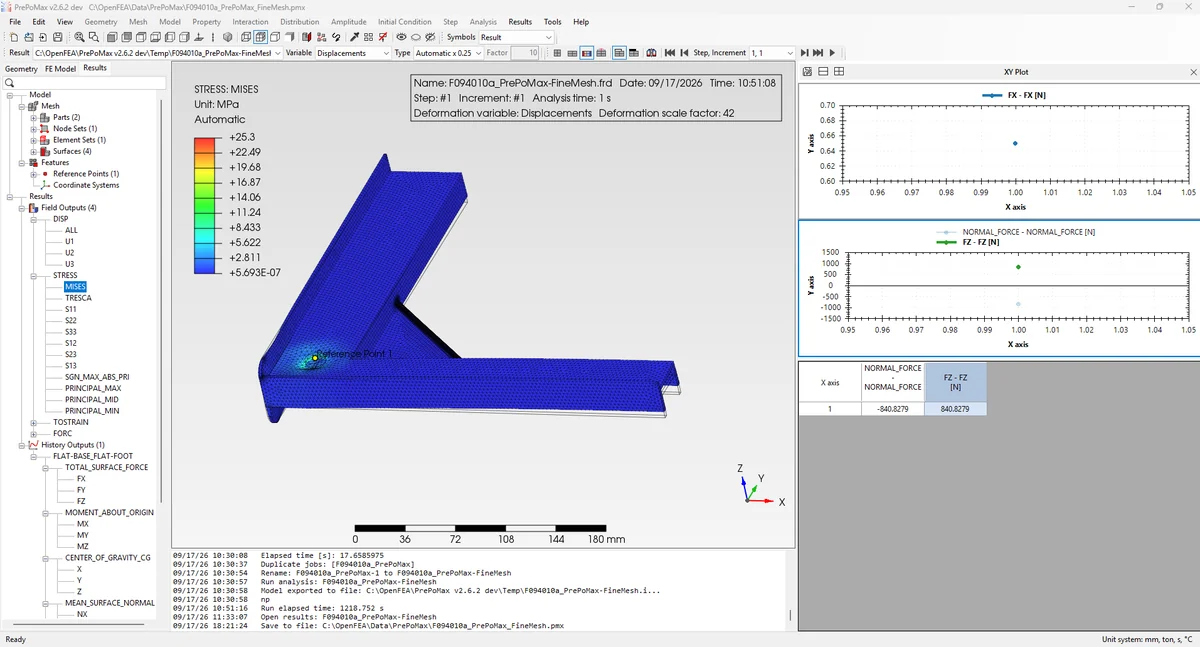
Von Mises stress result on a profile corner joint in PrePoMax
What it is

Small deformations, elastic material, steady loads.

A linear static analysis assumes that the part deforms little, that the material stays in its elastic range and that the loads do not change with time. Under those assumptions the model is fast and robust, so several design alternatives can be compared side by side.

It shows where stress concentrates, how stiff the design is, which areas carry little load and where the supports and joints are working hardest.

When linear is not enough

Contact that opens and closes, large deflections, plastic deformation or rubber parts need a non-linear model; loads that change quickly need a dynamic one.

Non-linear analysis
Dynamic / transient analysis

Typical questions

  • Is this plastic housing strong enough?
  • Where are the highest stresses and deformations?
  • Can the wall thickness be reduced?
  • Should the component be reinforced locally?
  • How does a design change affect stiffness?
  • Which design alternative best balances performance, weight and material?
Worked examples

How FEA fits into a wider engineering investigation.

Typical situations, described the same way: the request, what a complete assessment has to consider, what simulation adds, and what decides the outcome.

Product redesign · Material optimisation

Reducing the material in a plastic housing

A manufacturer wants to use less material in a plastic housing. The question is not simply whether a thinner wall gives lower stress.

A complete assessment considers
  • The actual loading conditions
  • Mounting and assembly requirements
  • Manufacturing limitations
  • Warpage and dimensional stability
  • Local reinforcement options
  • Material properties
  • Required stiffness
  • Expected service conditions
  • The cost benefit of the change
What FEA adds

It compares alternative designs and shows where material can realistically be removed.

What decides

The numerical results together with the practical requirements of manufacturing and use.
Product upgrade

An existing product for a higher load

A customer asks for an existing product with a higher load capacity. Redesigning the whole product is rarely the answer.

A complete assessment considers
  • Which components see the largest increase in load
  • Which areas may become critical
  • Whether the existing geometry remains adequate
  • Where reinforcement or a material change is needed
  • Secondary effects elsewhere in the assembly
What FEA adds

A detailed understanding of load paths and structural response.

What decides

Changes are targeted where they are needed, instead of redesigning everything.

Open-source FEA

Professional analysis, without enterprise licence costs.

Commercial FEA packages often cost thousands of euros a year per seat, and that cost ends up in the price of every study. We work with a mature open-source toolchain instead, so an SME pays for engineering time, not for software licences.

The solver, CalculiX, is a long-established finite element code that reads the widely used Abaqus-style input format.

Honest about the limits

Where a question genuinely needs a feature that only a commercial package offers, we say so before the work starts.

The workflow

  1. Geometry: FreeCAD

    The CAD model is prepared for analysis and simplified where details don't affect the answer.

  2. Set-up and mesh: PrePoMax with Netgen

    Materials, loads, supports and contacts are defined, each assumption is recorded, and the mesh is refined where stresses concentrate.

  3. Solution: PrePoMax with CalculiX

    The model is solved and checked: convergence, mesh sensitivity and plausibility against hand calculations.

  4. Post-processing: PrePoMax and ParaView

    Stresses, displacements and reactions are extracted and presented as clear images and figures for the decision.

Product names are trademarks of their respective owners.

Related projects

A real project.

Product engineering

A 3-axis gimbal for serial production

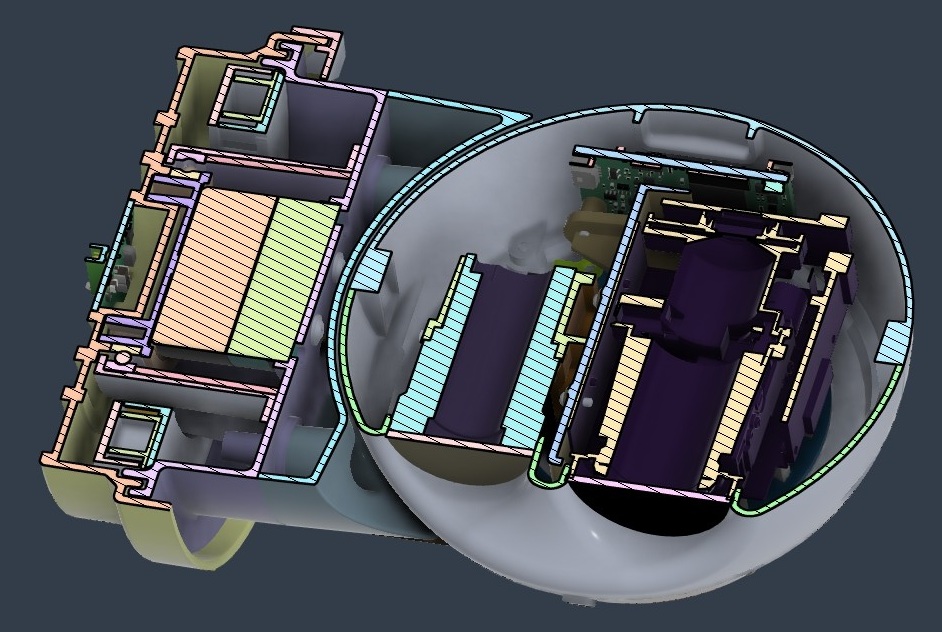
Parts designed for injection moulding, checked with FEA before tooling is committed.
See the project

All projects: FEA

Do you have an engineering question? Let's discuss it.

Tell us what you are developing, changing or trying to fix. We first look at the engineering question, then say plainly what is worth doing: a calculation, a design review, a test, a simulation, or a combination.

Complimentary first site visit & analysis Custom proposal, regardless of project scale Strict confidentiality & NDA protection