
Structural analysis (FEA): understanding how a part really behaves.
Finite element analysis of components and assemblies under mechanical and thermal loads, used when the engineering question needs more than a hand calculation, and interpreted with the realities of manufacturing and use in mind.
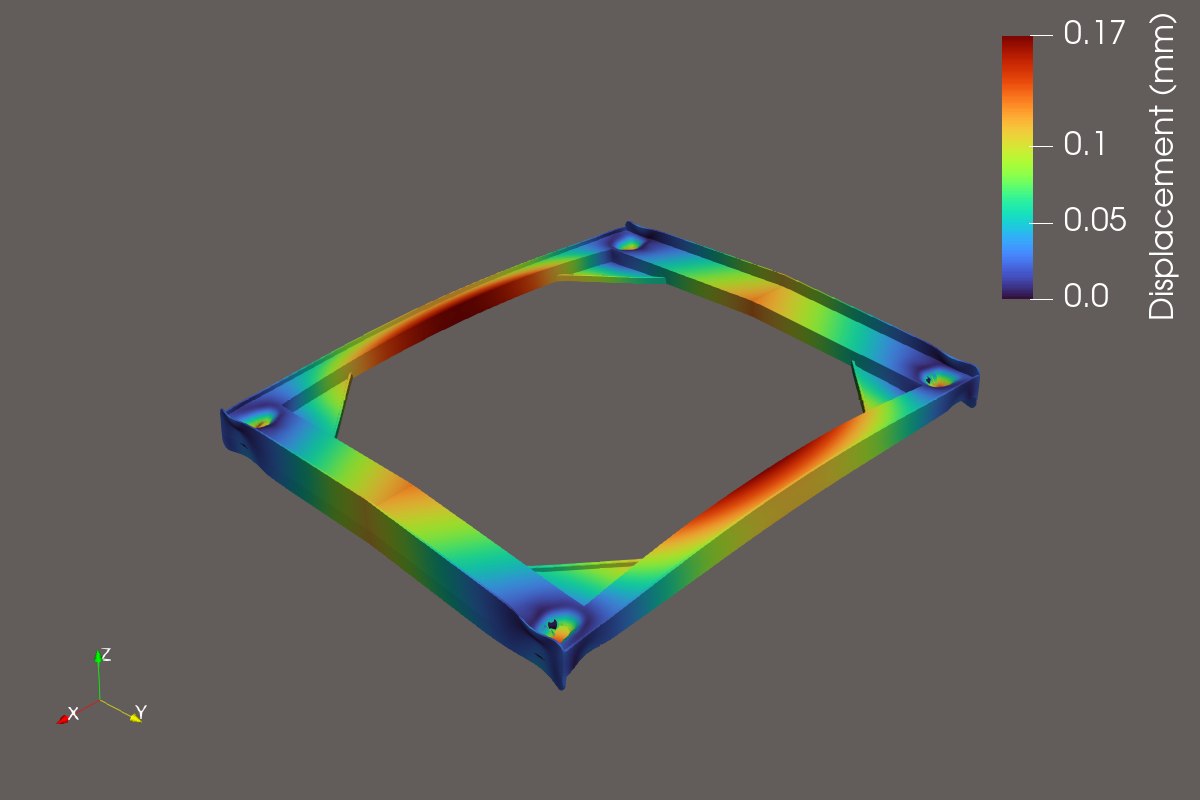
What an FEA study is usually asked to answer.
- Is this plastic housing strong enough?
- Where are the highest stresses and deformations?
- Should the component be reinforced locally?
- Can the wall thickness be reduced?
- Which components are affected by higher operating loads?
- How does a design change affect stiffness?
- What forces or deformations occur during assembly?
- Is a snap-fit likely to see excessive deformation or stress?
- Which design alternative best balances performance, weight and material?
Depending on the problem, the analysis may cover:
- Stress and strain
- Displacement and deformation
- Contact forces
- Reaction forces
- Stiffness
- Buckling susceptibility
- Natural frequencies
- Thermal expansion
- Temperature-dependent structural behaviour
- Drop Test
The purpose is not simply to calculate a stress value. It is to understand how the component behaves, where its limits may be, and which design decisions are worth investigating.
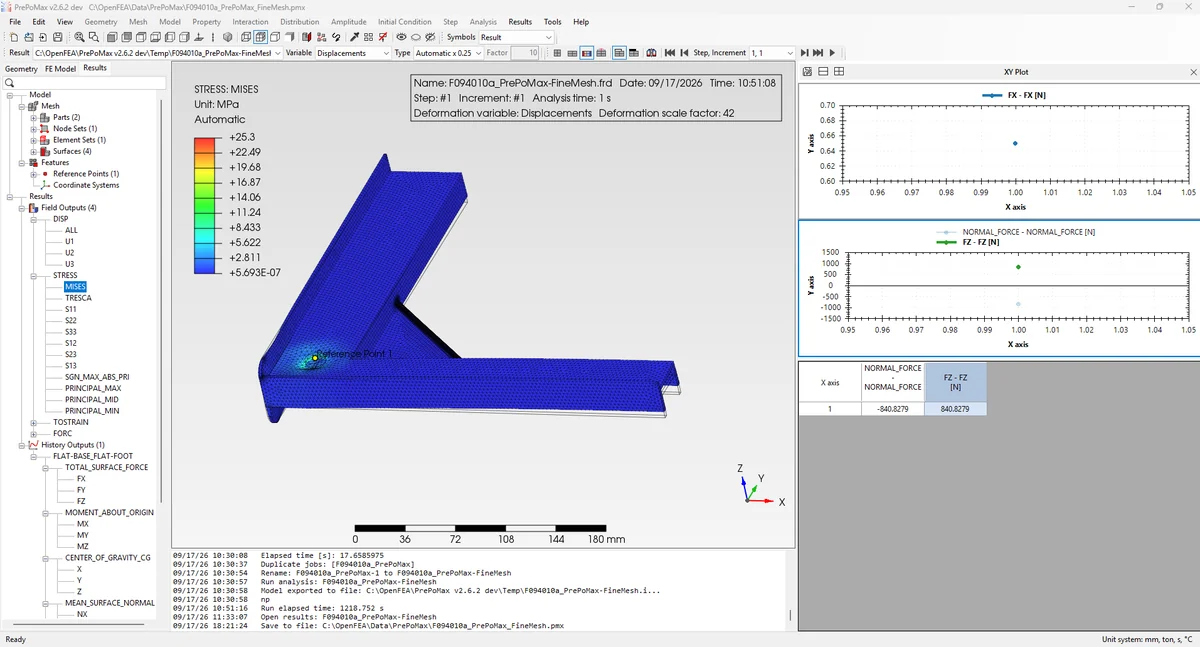
Professional analysis, without enterprise licence costs.
Commercial FEA packages often cost thousands of euros a year per seat, and that cost ends up in the price of every study. We work with a mature open-source toolchain instead, so an SME pays for engineering time, not for software licences.
The solver, CalculiX, is a long-established finite element code that reads the widely used Abaqus-style input format. We offer its full range of analyses, including:
- Linear and non-linear static analysis
- Contact between parts
- Large deformations and plasticity
- Hyperelastic materials such as rubber
- Buckling
- Natural frequencies and dynamic response
- Heat transfer
- Coupled thermal and mechanical analysis
Honest about the limits
Where a question genuinely needs a feature that only a commercial package offers, we say so before the work starts.
The workflow
-
Geometry: FreeCAD
The CAD model is prepared for analysis and simplified where details don't affect the answer.
-
Set-up and mesh: PrePoMax with Netgen
Materials, loads, supports and contacts are defined, each assumption is recorded, and the mesh is refined where stresses concentrate.
-
Solution: PrePoMax with CalculiX
The model is solved and checked: convergence, mesh sensitivity and plausibility against hand calculations.
-
Post-processing: PrePoMax and ParaView
Stresses, displacements and reactions are extracted and presented as clear images and figures for the decision.
Product names are trademarks of their respective owners.
From the question to a decision you can act on.
-
Define the question
What decision the analysis supports, and whether FEA is the right tool or a calculation will do.
-
Establish realistic inputs
Geometry, materials, loads, supports and operating conditions, with every assumption written down.
-
Build and check the model
Mesh quality, numerical behaviour, sensitivity to key assumptions, and comparison with hand calculations where possible.
-
Interpret for manufacturing and use
What the results mean for wall thickness, ribs, material, tolerances and cost, not just colours on a model.
-
Report and recommend
Findings, limits and uncertainties, and a clear recommendation, including physical testing when it is needed.
What you receive
- A concise report: question, assumptions, results, limits
- Annotated result images that explain what matters
- Comparison of design alternatives, when requested
- Concrete design recommendations
Assessment, not certification
An FEA study is an engineering assessment under stated assumptions. Where formal certification or regulatory approval is required, the work is scoped within the relevant standards and professional framework.
Results that are useful, transparent and properly qualified.
Every model requires decisions about:
- What should be included, and what can be simplified
- Which loads and operating conditions are realistic
- Which material properties are relevant
- Which boundary conditions represent the real application
- Which physical phenomena matter
- How the results should be interpreted
These decisions often matter more than the ability to produce a sophisticated-looking model, and they are where 35 years of industrial experience count.
Depending on the project, our work includes:
- Clearly defining the engineering question
- Documenting assumptions and input data
- Checking mesh quality and numerical behaviour
- Investigating sensitivity to important assumptions
- Comparing with hand calculations or known behaviour
- Stating limitations and uncertainties
- Distinguishing an engineering assessment from formal certification
- Recommending physical tests or measurements when needed
A simulation result should never be presented as more certain than the model and the input data justify.
Where FEA fits into a wider investigation
Discuss your engineering problem.
Tell us what you are developing, changing or trying to fix. We first look at the engineering question, then say plainly what is worth doing: a calculation, a design review, a test, a simulation, or a combination.